Unlocking The Potential Of Better Tech: Resources To View, Listen And Think Beyond Big Tech
Release 1 on 21st Dec 2025
Last Edit 25 th Dec 2025 (see *** at end of page for new history pod)
“In 2025, the European Union stepped up investigations of Big Tech companies for flouting rules on digital markets and services.” – EuroNews 17th Dec 2025 https://www.euronews.com/next/2025/12/17/eu-takes-on-big-tech-here-are-the-top-actions-regulators-have-taken-in-2025
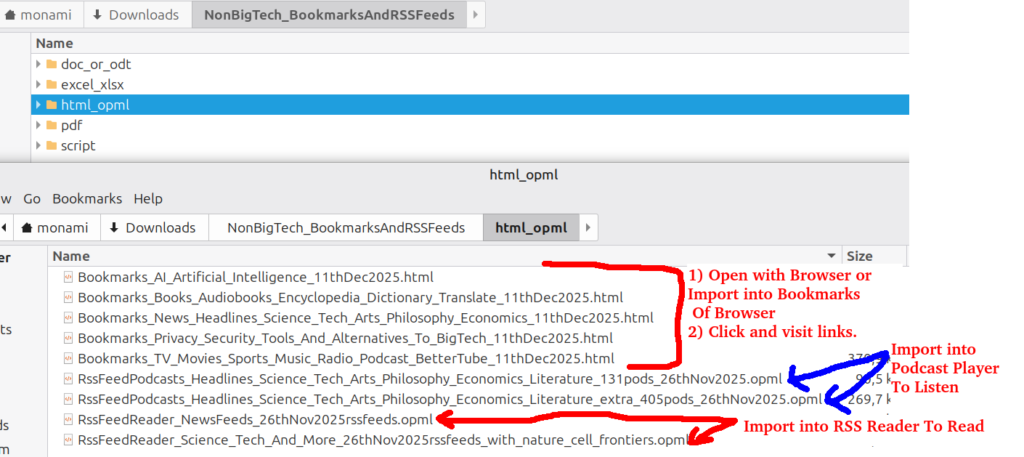
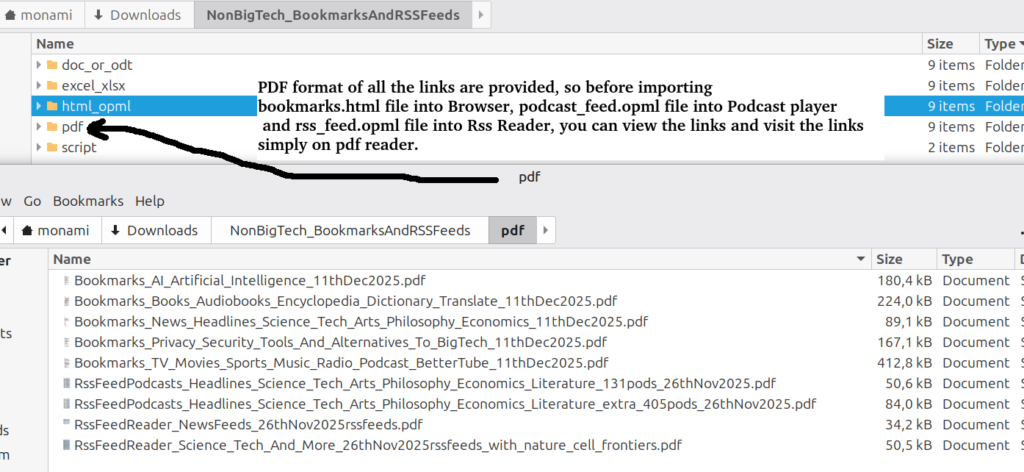
This guide will help you traverse the realm of non-big tech tools, where you’ll find that these alternatives not only prioritize your privacy but also deliver superior functionality and user experience. To get you started on this journey, here is presented for download (see link at end of this article) a meticulously curated list of bookmarks for your browsers, OPML for podcast players, and OPML for RSS feed readers, and more—all geared towards providing you with an array of privacy tools, AI solutions, streaming services (TV, Live, Movies), video platforms, radios, podcasts, music, books, and audiobooks. Dive into this world of tech innovation that puts your privacy first!
The fight against big tech monopolies, abuse of user privacy data security, purposeful addictive doom scrolling algorithms, and big tech especially social media misinformation and disinformation has seen some victories. Twitter was rightfully fined by the EU and Facebook banned for teens in
Australia. However, ensuring people are not left in an information vacuum requires a focus on verified information and platforms that cater to user-intentional views. To achieve this, adopting “old school” practices from before the big tech era could be helpful. Using RSS feeds for podcast listening and RSS feeds article viewing allows users to choose their preferred tools or platforms without being influenced by algorithms. This also eliminates the incentive for big
tech companies to collect and sell user data. Another method is using privacy-focused browsers in combination with VPN tools to visit non-big tech websites for information and entertainment. The RSS feed OPML files and browser bookmark files are provided to provide users with better tech alternatives to big tech. These better tech services include, subscription services, free services, open-source services, browsers, VPNs, email services, cloud services, podcast players and RSS readers. The goal is to enable user to take control of their online experience.
Although it may take time to adapt to these non-big tech tools or relearn old habits, the benefits are worth the effort. Freedom of choice, privacy rights, and fair competition in the marketplace contribute to a more just society. Examples of electronic versions of newspapers such as PressReader and subscription-based news readers from China Daily and The Telegraph offer digital newspapers that can be read from start to finish, providing users with information and satisfaction without being trapped in social media doom scrolling. Examples of IPTV (internet protocol television) such as plutotv, bbciPlayer, tubi, arte.tv and plus.rtl.de in combination with VPN and antivirus privacy tools provide greater consumer freedom by providing free legal alternatives to big tech’s or giant tech’s monopoly and user privacy abuse. On social media front, Fediverse social media platforms facilitate cross-talk between different networks and are decentralized, making them more robust against cyberattacks. In AI, EU + 1 (Switzerland) or EU et al, UK + 4 (Canada, Australia, New Zealand, Ireland) or UK et al, and Japan + 2 (South Korea, Singapore) or Japan et al are heavily focused on developing AI models that are not trained on ‘black-box’ plagiarized illegal data like big tech or giant tech companies such as OpenAI ChatGPT, Google Gemini, Meta Llama, X/Twitter Grok, Microsoft Copilot, Amazon’s Claude AI and DeepSeek etc, one is encouraged to use these EU et al UK et al Japan et al alternate fair AI models to get practice, because eventually these big tech and giant tech AI models won’t be around as they will be illegal — because these big tech AI models are trained on illegitimate plagiarized data and there is legal president with all plagiarism that the plagiarized publication must be removed and all benefits made from the plagiarized material gets forfeited.
When choosing privacy products, one should also appreciate the tougher fight US privacy focused companies like Brave, Firefox, DuckDuckGo Zoom and others have to endure relative to their EU et al UK et al Japan et al counterparts. This is because unlike EU et al UK et al Japan et al, these companies in US do not receive as much legal protection from getting acquired by US big tech and US giant tech companies — the big tech and giant tech companies are like Pacman in Pacman game, devouring powerful competitors like Power Pellets. In US there is insufficient regulatory safeguards, in contrast to EU et al UK et al Japan et al regions where regulators proactively detect and prevent big tech and giant tech, investments and acquisitions. For instance, the EU and UK blocked Amazon’s robotics acquisitions and Microsoft’s Mistral AI acquisition, while in the US, acquisitions such as Amazon’s takeover of Whole Foods, Facebook’s acquisitions of WhatsApp and Instagram, Elon Musk’s acquisition of Twitter’s X, Microsoft’s acquisition of LinkedIn and Github, and Google/Alphabet’s acquisition of Youtube were not prevented by US regulators. As users, by using products from entities (open source or commercial) that staunchly resist big tech and giant tech, users can ensure that privacy focus remains profitable for these entities. Indeed, one cannot compare ones two eyes, but perhaps the double battle that the US privacy focused entities fight of no regulatory protection plus hostile acquisition or investment mediated shadow ownership tactics of big tech and giant tech in US, makes them greater warriors of fair privacy focused tech, than their EU et al UK et al Japan et al counterparts who have the regulatory protection. Therefore, it is essential to stay informed about the news to ensure that these US privacy products are indeed navigating clear of big tech acquisitions and investments to safeguard your privacy.
In summary, by overcoming the learning curve of using non-big tech tools, users will discover that these alternatives not only protect privacy but also provide better functionality and user experience overall. To get users up and running on this path, I provide a list of bookmarks for your browsers, and opml for your podcast players, and rss feed readers, which encompass privacy tools, AI tools, streaming services (TV, Live, Movies), video platforms, radios, podcasts, music, books and audiobooks (see link at end of this article).
Download link http://e.pc.cd/LEPy6alK for folder ‘NonBigTech_BookmarksAndRSSFeeds.zip’. Download it, extract (unzip) the contents to view and use.
*** Feel free to add this manually, because it is new release and will be added to podcast OPML file in future update of ‘NonBigTech_BookmarksAndRSSFeeds.zip’ folder:
https://podcastingtoday.co.uk/piers-morgan-launches-history-uncensored-as-first-podcast-spin-off-series/